Control that converts: how device management protected Jusbrasil's revenue and boosted profits by ~20%
- Company
- Jusbrasil
- Year
- 2025
- Status
- Shipped
The problem
Jusbrasil had become one of the most widely used B2C products among lawyers in Brazil. As usage scaled, we started seeing discrepancies between product usage and our subscriber base.
We had a strong signal that accounts were being shared.
The signal
I paired behavioral data with interviews to find out what multi-device use actually was.
- 01
Multiple devices didn't mean account sharing
Legitimate customers regularly switched between work and personal devices.
- 02
Sharing was often about convenience
A password was simply the easiest way to give someone access.
- 03
A hard block would create unnecessary friction
Controlling access is not the same as preventing it.
- 04
Multi-device usage was the norm
80%+ of paying users accessed Jusbrasil from multiple devices.
The opportunity
Turn access control into a path to legitimate usage and subscriber growth.
Rather than treat every extra device as abuse, add friction gradually and leave a way out. The goal wasn't to stop sharing — it was to convert it.
Exploration
I explored how to introduce friction without breaking the experience.
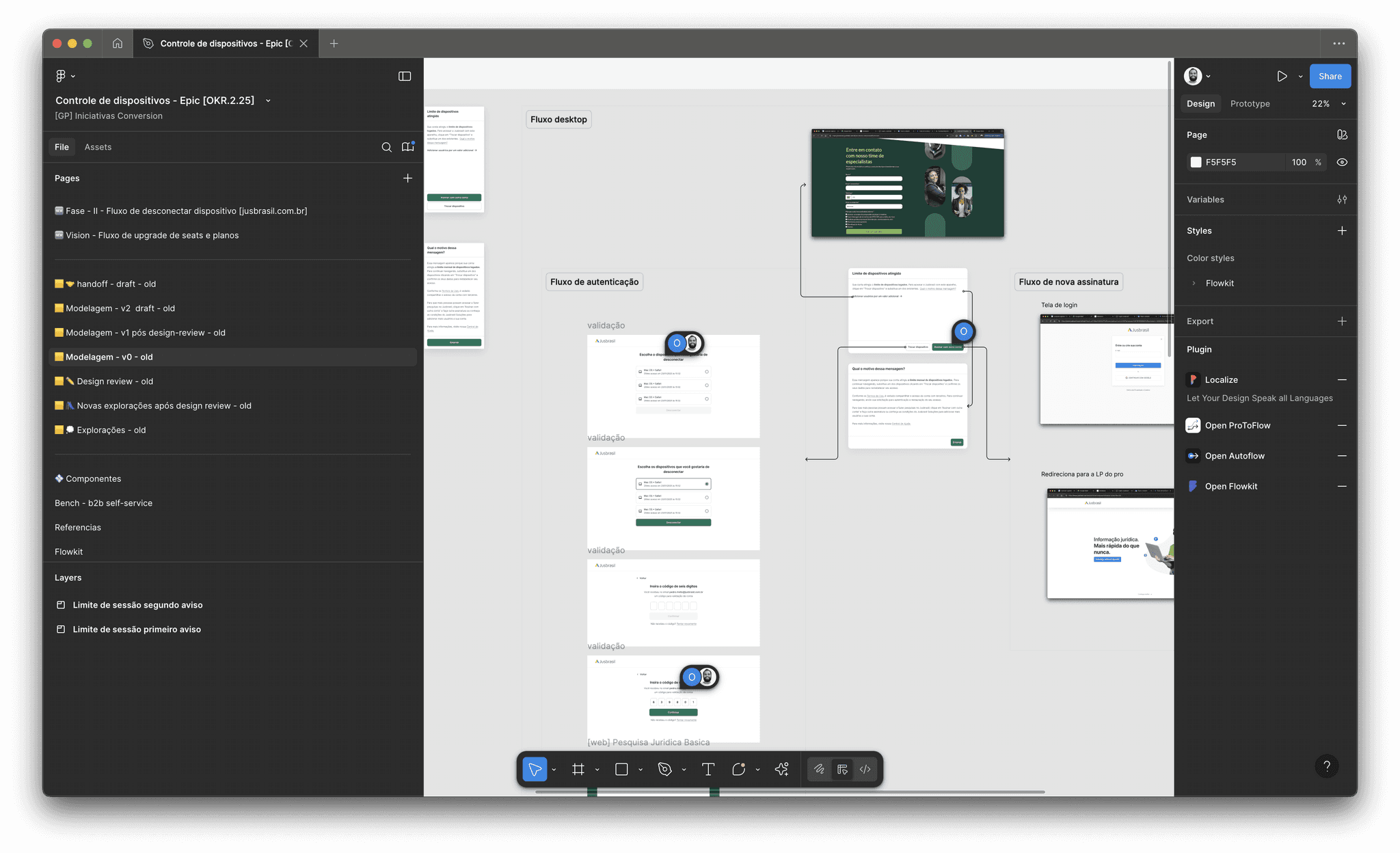
I designed and tested different approaches to device limits, warnings, verification and additional access.
The trade-off
How much friction can we introduce before legitimate users start feeling punished?
Based on everything we knew at this point, we made a decision. Instead of outright blocking additional devices, we introduced warnings and limits gradually, giving legitimate users a clear path to continue.
What we learned
The restriction worked better when customers understood why.
Testing showed that users needed clear context before being blocked — and a clear path to resolve the restriction.
Iteration
Progressive warnings
Customers received increasingly clear warnings before reaching the device limit. I wrote every piece of copy with our compliance team, so the blocking system explained itself.
Verification
A verification step helped distinguish legitimate access from unauthorized sharing. The verification flow was designed to be straightforward and assist users in making their decisions.
Self-service access
Customers can purchase additional access instead of being permanently blocked, allowing us to increase growth opportunities and protect our revenue.
Results
Control without turning the experience hostile.
- +20%
- revenue from seat expansion
- +50%
- shared accounts blocked
Unmanaged sharing went down, and part of it turned into revenue.